H. W. Arlin: Broadcasting Radio in the 1920s
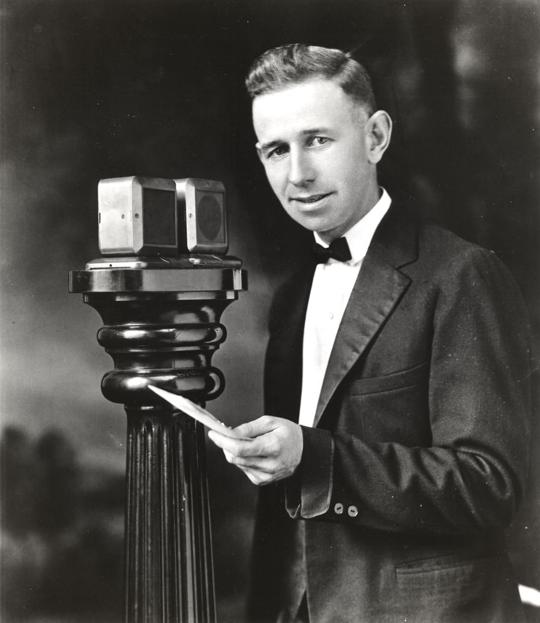
Announcing radio programs might be called the world's most recent profession, because announcers for broadcasting stations were introduced first about four years ago when KDKA, the world's pioneer station of the Westinghouse Company at East Pittsburgh, Pa., was started.
H. W. Arlin, the world's pioneer radio announcer, made his debut early in 1921 and has been continuously "on the air" since. Thus his long service entitles him to the honors of being the veteran of radio announcers.
Arlin's studio experiences have been many and varied. Life as a radio announcer is not a drab affair, as there is a necessity of being continually on the "qui vive."
In the following interview Arlin tells of some of his studio experiences and some interesting contacts with his radio public.
"I am often asked the question, 'Do you become tired of announcing?' or 'Does radio work become monotonous?' My answers to such questions are always in the negative, thanks to an ever-curious and an assisting public. By such an answer, I mean that any monotony which might otherwise tend to creep into the almost continual execution of programs is quickly dispelled by a multitude of extraneous duties with which an announcer is confronted.
"Probably one of the most interesting phases of studio work comes through contact with the public, not entirely by personal association, but also through the telephone and telegraph. No work can become monotonous or tiresome where the public is involved . On the contrary, I have found that a study of the whims and fancies of the public has been an exceedingly interesting one. Paraphrasing the famous expression of Abraham Lincoln, 'You can please some of the people all of the time, and all of the people some of the time; but you can't please all of the people all of the time.' Not in radio, at any extent. This statement could be applied to the view of the public on any one phase of radio entertainment such as music or sports. When applied to all of the phases of radio, it becomes many more times effective. What one person likes, another dislikes, and what one person condemns, another approves; so an announcer is almost justified in concluding that a 50-50 break with the listening public is fair enough, However, 100 percent satisfaction is always the goal.
"In telling of the announcer's contact with the public we may take into consideration only one phase of this contact; that of telephone conversations. The nature of the telephone messages received, together with the conversations that follow, tend to create in one a desire for the study of people. The thoughts and ideas which prompt these many calls are perhaps innumerable; perhaps some one conceives an idea by which radio can be of aid to him in his own personal advancement or the advancement of some pet theory, or possibly someone desires some information which may vary from that of a query regarding what is the proper food to give a sick baby to that of certain details regarding a program to be broadcast several weeks hence.
"A few of the seemingly endless number of such questions and requests may be of interest. A confiding interest in our listeners, (this same public) will necessitate the omission of the names of any personalities involved in the following:
"One of our good Canadian friends recently called to tell us about a circular parking station he had invented for automobiles which would handle 200 cars and which could be operated by one man . Appreciating the need for better parking service and predicting great success for his venture, he requested that we advise the radio public of his invention with full details as to where to purchase these stations.
"A lady calls us and requests that we announce that she has just left a package of pajamas on the street car and would like to have the service of the radio in recovering them. After being informed that we never make local announcements except in cases of robberies, kidnapping, lost persons and such emergencies, she replies, 'Well, this is an emergency case, because it is the only package I had.'
"An elderly lady, apparently a student of nature, calls and gives us the following important news item: 'Will you please announce that t here is about four inches of snow in my backyard and that I have just seen two cardinal red birds?' Of course, a very usual sight for this time of the year.
"No sooner is the telephone receiver on the hook than the bell again rings and an innocent feminine voice pops the following impression: 'I just heard you announce that you had received a telegram from New York commenting on the program. I would like to know if you are also broadcasting to Ohio tonight, as I would like to request a number for some friends out there who do not have the advantages of a radio.'.
"It has also been brought very forcibly to my attention that radio has made a greater impression upon the public than has music. Of the many proofs of this statement, I might cite an occasion on which a program was being presented by the great Fritz Kreisler.
The telephone rings and the following question comes from one of our listeners: 'Do I have to listen to that novice all evening?' A very provoking question to ask an announcer on such an occasion. He was then asked if he knew who he was listening to and after replying in the negative, he was very politely told that if his set was not working properly or that if he didn't appreciate the music, he was in no way obligated to keep on listening the rest of the evening. This, apparently, answered his first question satisfactorily, and was an answer which fortunately savored very little of the thoughts that were running through the announcer's brain.
"A lack of appreciation for the success of artists or for the repertoire used by them sometimes results in requests which provoke a smile from the person to whom they are addressed. When presenting a program at KDKA recently Christine Miller Clemson, who before her marriage was one of the country's contraltos and a concert singer with an enviable record, was requested to sing the jazz number 'Red Hot Mamma.'.
"Perhaps one of the most common requests received is that requesting an artist to sing a particular number. In spite of the fact that there are thousands of songs, a good many listeners cannot quite understand why the singer does not have the particular number they request. Song pluggers are requested to sing 'Arias' and grand opera stars are requested to sing jazz numbers by the well-meaning audience. It also happens quite often that in spite of the fact that we receive hundreds of requests for numbers during a particular evening, some well-meaning individual is at a loss to know why his or her particular request was not granted.
"Oftentimes a party will call and ask the following question or a similar one: 'I have a five-tube neutrodyne set and cannot hear anything. Will you please tell me what is the matter with my set?' The opinion seems to be quite prevalent among a good many listeners that the wavelength determines the distance which a station can be heard, and usually the belief prevails that the distance a station can be heard varies directly with its wavelength. This opinion is the cause of some very humorous questions being asked.
"Among the innumerable questions are such questions as these: What time is it? Where is station WXV located? What is the name of the waltz the band played last Saturday night? What is the wavelength of station WXV? How far are you broadcasting tonight? Who is going to give your program on the 2nd of next month?'
"And so the announcer soon finds himself converted into an information bureau from which the dissemination of news adds a very colorful diversion to his vocation."
From Radio Age, June 1925
Harry Ackerman Produced Our Miss Brooks, Gunsmoke on Radio
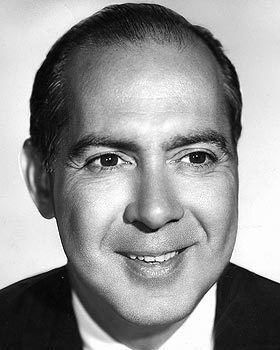
Harry Ackerman, long-time executive at CBS radio died Feb. 3, 1991. He worked on many of network radio's successful shows, including Our Miss Brooks and Gunsmoke.
After graduating from college in 1935, Ackerman became an assistant to Raymond Knight and appeared as part-time announcer and comic poet on Knight's Cuck Coo Hour at NBC. Later he became the assistant director of the Phil Baker Show.
From New York he moved to Detroit, where he was hired as agency producer for The Lone Ranger. Then he was hired to produce two Hollywood programs, The Phantom Pilot with Howard Duff and Elliott Lewis and Landendoft News Dramas, which he later described as a "kind of West Coast March of Time."
When Ackerman was Sperdvac's guest in 1988, he recalled with pleasure his work on the Gulf Screen Guild Theatre, which featured performers who donated their earnings to the Motion Picture Home. "That was a dream experience," he observed. "In the three years I was producer/director. I had absolute carte blanche. 1 could do any script I wanted and cast it with whatever stars I could find available.
Ackerman was supervisor of programs, and later vice president in charge of programs, at Young and Rubicam in 1948, when CBS hired him to work as an executive producer in New York. There he was in charge of all CBS programs originating from New York. Six months later he was transferred to Hollywood to be head of West Coast programming for the network.
For a while, he continued to work as director of The Aldrich Family on NBC, even though he was a CBS executive.
He was still in New York when CBS was about to bring Our Miss Brooks to the radio airwaves. He tried to get Shirley Booth to play the lead. "All she could see was the down side of the underpaid teacher. She couldn't make any fun of it," he observed. Following his transfer to California, Ackerman hired Eve Arden to play the lead.
After bringing the Adventures of Phillip Marlowe to CBS, William S. Paley asked Ackerman to "develop a Phillip Marlowe of the early west." The result was Gunsmoke. At the first he and others at CBS were not sure what position the lead Gunsmoke character should have. "We experimented in writing scripts with him as sheriff for a while and I think in one version we had him as a private eye," Ackerman told SPERDVAC. "Then we finally settled on him being a marshal.
His job at CBS included responsibility for the continued success of the programs that moved from NBC to CBS during the famed 1948 talent raid. "When you're responsible to a boss like Bill Paley, you've got to turn out an excellent product or you'll lose your job," he commented.
Dan Haefele in Sperdvac Radiogram, March 1991
For Police Detective Danny Clover, Broadway is My Beat
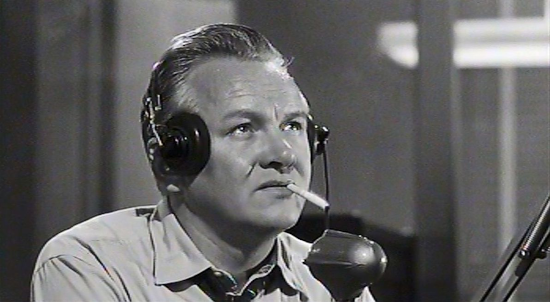
With the musical refrain of "I'll Take Manhattan," and the sound of impatient car horns in the background, another episode of Broadway is My Beat begins. New York police detective Danny Clover informs us that "Broadway is my beat. From Times Square to Columbus Circle -- the gaudiest, the most violent, the lonesomest mile in the world."
Homicide detective Clover, played by Larry Thor, narrates the introduction to each program's plot. In "The Thomas Hart Case," broadcast April 14, 1951, his calm, yet intense voice begins another episode, his narration blending smoothly into the action of the story.
"The day without color is only six hours old and the restlessness begins to eat at Broadway. The waiting, the longing for the night time begins to grow like hunger, like thirst, because Broadway's night is a banquet, loaded with delicacies. The scarlet wine of neon. The forbidden fruit of a trumpet's scream. The lukewarm stew offered on a tin plate through an alley doorway. But, Broadway's day -- that's the drab time, kid, the empty time. The time of leaning against sun-warmed stalls and waiting. And you wait for the rest of Broadway, because it'll come -- something will come. And it does. You know that, because Broadway nudges you with an elbow, winks and says 'follow me, kid.' The day has turned bright and it's not far away where the day is bright -- on 39th Street just off 7th Avenue in the garment center. The crowd is already there ahead of you, toothpicking its last bite of lunch, digesting the spectacle of a man sprawled on the pavement. There was a scissors in his back."
And so, with poetic metaphor, Clover is challenged with another crime, another mystery, another case to solve.
The show originally was broadcast from New York, February 27 to May 29, 1949. Actor Anthony Ross was the original Clover. In July 1949, the series moved to Hollywood. The title of each show was the name of that week's victim. The first Los Angeles launched episode, "Jimmy Dorn," began a seven-week summer season that ran from July 7 through August 25 of that year. The first full season program, "Mei Ling," was heard November 5, 1949. The final broadcast, "Floyd Decker," was aired August 1, 1954. In all, there were 194 episodes.
Anthony Ross continued to play Clover through June 23, 1950. Then, on July 3, 1950, when the show moved from Fridays to Mondays, Larry Thor became Clover. Before starring in Broadway is My Beat, Thor was the announcer for two other crime/adventure series: Rocky Jordan (1945-47) and The Green Lama (June to August 1949). Other case regulars on Broadway is My Beat were Charles Calvert as Sgt. Gino Tataglia (no other known credits) and Jack Kruschen as Sgt. Muggavan. Kruschen also had worked on many other shows, including Pete Kelly's Blues, Escape and Gunsmoke.
A "Who's Who" list of Hollywood radio actors had periodic supporting roles on Broadway is My Beat. Some of the better-known cast members included Hy Averback, Harry Bartell, Herb Butterfield, Mary Jane Croft, Lawrence Dobkin, Herb Ellis, Sam Edwards, Sheldon Leonard, Barney Phillips, Irene Tedrow, Anne Whitfield and Ben Wright. Most of these character actors also had performed on one or more of the following shows: Gunsmoke, Escape, Crime Classics, On Stage, Nightbeat, Pete Kelly's Blues and Yours Truly Johnny Dollar, to mention just a few.
Bill Anders did the announcing. He also had been the announcer on the short-lived (July to September 1951) Mr. Aladdin detective show starring Paul Frees, written by Dick Powell and directed by Elliot Lewis. The musical score for Broadway is My Beat was composed and conducted by Alexander Courage. He would later write the theme music for the original Star Trek television series.
Lewis, the show's producer and director, was a man of many talents. He had already established himself as a versatile radio actor, writer and producer. But Broadway is My Beat was his first directing effort. Lewis had an advantage as a director. He was born in Manhattan and had first-hand knowledge of the flavor, pulse and pace of the city. Some of his major acting credits include playing Frankie Remley on The Phil Harris and Alice Faye Show (1946-48), Archie on The Adventures of Nero Wolfe (1943-44), Captain Bart Friday on Adventures by Morse (1944-45 -- shared with David Ellis and Russell Thorson), and Gregory Hood on The Cast Book of Gregory Hood (1948).
In addition, he directed the CBS Radio Workshop and was creator-producer-director of Crime Classics. In his later years, Lewis wrote a series of detective novels and served as a script consultant on the Remington Steele television show. For Broadway is My Beat, Lewis used three sound men to recreate the sometimes noise sounds of the city. Simply stated, in his words, "Even the people in New York are noisy."
Morton Fine and David Friedkin wrote the finely honed and creative scripts for Broadway is My Beat. They also collaborated on scripts for Bold Venture, Crime Classics, The Front Page, The Lineup, Phillip Morris Playhouse, On Stage and Yours Truly, Johnny Dollar, among others. In addition, they were two of the producer-directors of Escape.
To say that Broadway is My Beat had the services of some very talented and creative people would lean towards understatement.
The CBS network press kit provides some insight into the main character of the series. "As a kid, Danny Clover sold papers and shined shoes along the Great White Way, and later pounded the beat as a policeman. He knows everything along Broadway, from panhandler to operatic prima donna, but he's still sentimental about the street -- forever a wonderland of glamour to him."
Now, back to the Thomas Hart Case. Having successfully brought the criminal to justice, Clover ends the show with the following reflections:
"In the April night, Broadway echoes with sounds heard only in darkness. The whispers that speckle places where there's no sun. There's a touch on your coat. You turn. There's no one. Nothing. Only the trail of dust on your shoulder. It's Broadway. The gaudiest, the most violent, the lonesomest mile in the world. Broadway. My beat!"
Charles Beckett in Return With Us Now, March 2004
World's First Scheduled Radio Broadcast Came from Pittsburgh
The National Broadcasting Company's Silver Jubilee celebration on November 15, 1951, brings to mind another, even earlier, November day when the world's first scheduled broadcast was heard over KDKA, Pittsburgh, pioneer radio station. Presentation of this inaugural broadcast on November 2, 1920, came about as the result of several strange and seemingly unrelated circumstances.
It all began in 1915 with a Westinghouse engineer, Frank Conrad. Westinghouse had been experimenting with the vacuum tube while working on government contracts. To settle a five-dollar bet on the accuracy of his twelve-dollar watch, Conrad built a small receiver to hear time signals from the Naval Observatory at Arlington, Virginia. Fascinated by his new hobby, Conrad turned next to construction of a transmitter, licensed as 8XK, which he installed above his garage in the rear of his home. It is from this station that KDKA stems and with it, radio broadcasting as it is today.
By 1919, messages from 8XK were heard in widely separated locations -- messages discussing the kind of equipment being used and results obtained. Bored by this routine, Conrad, on October 17, 1919, placed his microphone before a phonograph and substituted music for the voice. The music saved Conrad's voice, but more -- it delighted and amazed "hams" all over the country.
Conrad continued to broadcast music on a two-a-week schedule and by late summer 1920, interest had become so general that the Joseph Home Co., a Pittsburgh department store, ran an ad in the Pittsburgh Sun offering "Amateur Wireless Sets for sale -- $10.00 and up."
To H. P. Davis, Westinghouse vice president, who had been an ardent follower of the Conrad ventures, the ad was an inspiration. If this was a fair example of popular reaction to Conrad's broadcasts, the real radio industry lay in the manufacture of home receivers, he reasoned, and in supplying radio programs which would make people want to own such receivers. Davis set about winning other Westinghouse officials to the same view, and so persuasive were his arguments that a station was authorized and election night selected for the grand opening.
The broadcast originated in a tiny, makeshift shack atop one of the Westinghouse buildings in East Pittsburgh. There was no studio. A single room accommodated transmitting equipment, turntable for records; and the first broadcast staff handled telephone lines to the Pittsburgh Post where arrangements had been made to secure election returns by telephone.
Broadcasting began at 8 o'clock election night and continued until noon of the following day, even though James Cox, hours earlier, had conceded the election to Warren Harding. Throughout the night, while the usual crowds stood in a driving rain before outdoor bulletin boards to see returns, a fortunate few, early-morning fans, equipped with crystal sets and earphones, were hearing the same returns in the comfort of their homes. In addition, between returns and occasional music, they heard this request over and over again: "Will anyone hearing this broadcast communicate with us, as we are anxious to know how far the broadcast is reaching and how it is being received." So KDKA was born.
Much of the early history of KDKA is actually the early history of radio. Many of its notable "firsts" are "firsts" of the industry as well. And these KDKA "firsts" have put the station in history books.
From Radio-TV Mirror, November 1951
Catching Up with the Cast of Straight Arrow
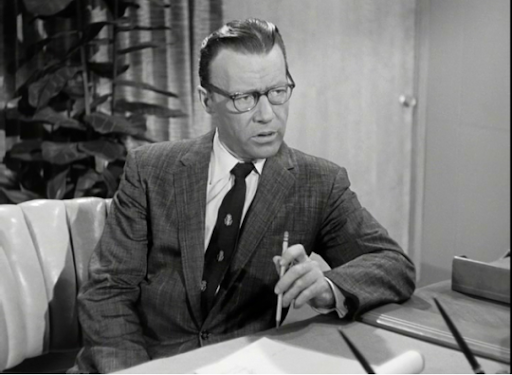
My former agent just forwarded to me the letter you wrote inquiring as to my present whereabouts. As this letter will attest, I'm alive and well, continuing to ply my craft in southern California.
You must have a great ear for voices to have remembered mine over a span of some 25 years.
Since the demise of Straight Arrow I continued to work in television, theatrical movies and radio, until drama disappeared from the audio waves. Recently, during a brief resurgence of the radio art, I worked many of the Sears and Mutual Radio Theater shows.
Frank Bingman, the announcer on Straight Arrow, is retired, living on his hilly 60-acre ranch above the Mojave Desert in L.A. County. I see him occasionally.
Fred Howard, "Packy," I have lost track of and fear he may have shuffled off this mortal coil. He had retired several years ago in an area near Oceanside. That's between L.A. and San Diego.
Gwen Delano, "Mesquite Molly," died just a few years after the series ended.
The original director of the show retired several years ago as vice president of the ad agency that produced the show for Nabisco. You may have read something of him in recent months -- Neil Reagan, older brother of the current president of the United States.
I have had the pleasure of working several radio shows with Ronald, and found him to be an intelligent, hard-working, pleasant individual.
That should bring you up to date on the status of the regular crew from the old Straight Arrow show, plus a bonus sidebar on our First Family.
Howard Culver, Collector's Corner, Summer 1982
Algiers Was Hedy Lamarr's First Performance on Radio
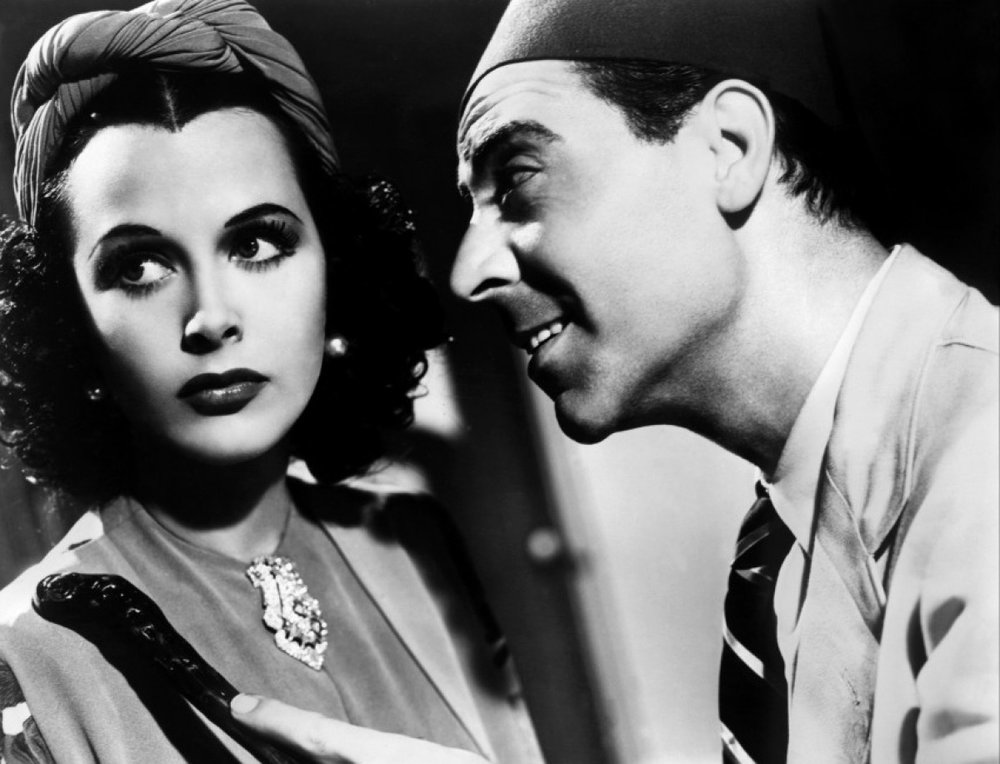
Since Metro-Goldwyn-Mayer's picture Come Live With Me with Jimmy Stewart, little has been heard from Hedy Lamarr, one of Hollywood's most glamorous ladies who broke into screen fame with her rather unclad part in Ecstasy, a European picture. It was therefore with interest that the editors of Movie-Radio Guide observed that Hedy (she likes it pronounced Hay'-dee) was booked by the DeMille Radio Theater to co-star with Charles Boyer in a radio adaptation of their Algiers.
This was news from two points -- first, because it was the final performance of the season for the Radio Theater, and second, because it was Lamarr's very first radio broadcast.
A third point of interest was the rumor that the Viennese ex-stenographer had been feuding with her home studio and was on suspension. At radio rehearsal she was interviewed.
"Have you been off pay or on suspension?" she was asked. "I haven't missed a single week getting my paycheck," she replied. "Here, do you want to see it?" I did, naturally enough, but being a gentleman said no and let it pass. But I did observe in talking to her that she obviously was under a great tension just before the broadcast. Who wouldn't be -- breaking into radio in a program with 25 million listeners throughout the country waiting to say, "she's awful!"
It developed during our chat that Lamarr has been on a three-month vacation following Come Live With Me.
The glamorous brunette was clad in a black chiffon floor-length dress, and was wearing black wedgie sandals over bare feet, with her toenails enameled a cherry red. She was plenty nervous about that first broadcast, too, but was calmed considerably by Cecil B. DeMille, producer of the program, who succeeded in making her laugh just before the "on the air" sign flashed, and also the ever calm Charles Boyer.
We listened to her Algiers. She'd lost much of her accent, and her radio version was not quite as sure as her screen Algiers. We checked with our better half for her opinion. She said: "Hedy sounded just like Joan Bennett." That was a compliment, because La Bennett is an accomplished sure-fire radio performer.
Gene Markey would have agreed. He was married to both actresses in turn.
Evans Plummer in Movie-Radio Guide, August 9, 1941
Amanda Snow: From a Nightclub to Gospel Radio
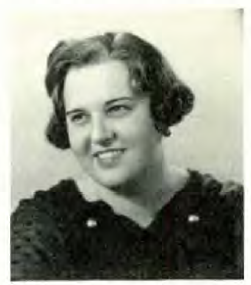
Hymns have always been joyous and inspirational music to Amanda Snow, NBC's newest singing personality. Perhaps that is why she is now a radio star.
To begin with, Snow sang in the Rockford, Illinois, Mission Tabernacle and its Bethesda Church. She later sang in the First Swedish Baptist Church of Minneapolis before coming to New York. And when she finally came to the Big City, she didn't forget her hymns.
When Snow came to New York for an audition, she was reluctant to offer hymns as a sample of what she had to offer a large audience, After all, she concluded that perhaps hymns and homey patter were all right for listeners back in Minneapolis. But maybe this audience was different. What would their reaction be?
Accordingly Snow devoted the first part of her audition to semi-classical selections. But it was the second half in which she sang her beloved hymns and spoke in her cheery voice, that really impressed the auditioning executives. The result found her with a six-times weekly program over a large network of stations.
Strangely enough, though, the "voice in the old village choir" began her commercial singing career in, of all places -- a nightclub.
Snow was residing in Minneapolis at the time, and although she sang soprano for the church congregation, she had no idea of becoming a singer, Her sister, Miriam, was the "voice" of the family. Miriam was a professional singer in a Minneapolis nightclub, while Snow was the "home girl" of the family. One night Miriam could not fulfill her engagement and pleaded with Amanda to take her place,
Amanda Snow agreed only because a singer was absolutely necessary to satisfy the club's patrons. When the manager asked her what type of songs were her specialty, you can just picture the expression on his face when Snow told him in one word. Simply "hymns."
Under the doubtful eye of the manager, Snow came out on the night club floor, and instead of singing torchy numbers amazed the gathering with several beautiful hymns. To her surprise-and the manager's, she received encore after encore and as a result was offered a professional contract on the spot. She accepted on condition that she be allowed to choose the numbers she would sing. And while sister Miriam sang hot, torchy numbers, Amanda stuck to her hymns.
When she was offered a chance to sing on station WTCN in Minneapolis, she left the employ of the nightclub and remained with the station for some time. Here, she had an opportunity to sing all the hymns she pleased and had ample time to take vocal lessons and increase her repertoire. Then she came on to New York and auditioned successfully.
Snow weighs 287 pounds but she doesn't care who knows it. In fact, she tells people she weighs 300 pounds. "After all," she says, "I have a round figure so I might as well make it a round number."
She doesn't resent anyone kidding her about her weight but when it is carried too far she's ready with fitting reply. There was the time a particularly persistent heckler asked her where she came from and she good-naturedly replied "Minneapolis." The would-be smart guy smirkingly inquired if they had enough room for her there. "Don't forget," squelched the alertful Snow, "Minneapolis is called the Twin City."
Snow intends to adhere to the homey type of program featuring the old-fashioned favorites, hymns and her cheery patter. Religion she believes, should be given more emphasis through radio.
"Perhaps the public is realizing," says Snow, "that religion, of which trust and faith are the forerunners, does bring happiness. All music should be sung joyfully-and religious music most of all. People are undoubtedly also realizing that hymns can be gay and joyful too, In radio generally the mood is being felt in the increasing popularity of religious programs and singers. The Hymn Singer, Ed McHugh, the Gospel Singer, The Hymns of All Churches program and Smilin' Ed McConnell are all programs having a large audience.
"If your heart is happy and you are sincere, then you can sing hymns with meaning, Proof of this is found in the many letters I receive from persons who say the old songs about the simple virtues make them happy. That is exactly what real religion should do for everyone."
Elmore Peltonen in Rural Radio, November 1938
Subscriptions

People
Topics
Projects
Statistics

This blog has been published since May 29, 2020 (a span of 2,083 days).
Top 10 Articles
- The Marriage of Don Ameche and Honore Prendergast
- The Earliest Radio Shows of the 1920s
- Early Radio Announcers Invented Their Profession in the 1920s
- The Night Arthur Godfrey Fired a Singer On Live Radio
- The Great Radio Detectives of the 1950s
- The Mythical Town of East Tincup, Colorado
- What's in a Name? A Lot in Portland Hoffa's Family
- Why Vladimir Horowitz Stopped Performing in the 1930s
- The Home Life of Jack Benny
- Phil Harris: Why Alice Faye Moved from Movies to Radio
Winnetoba Radio hosted by Workbench
